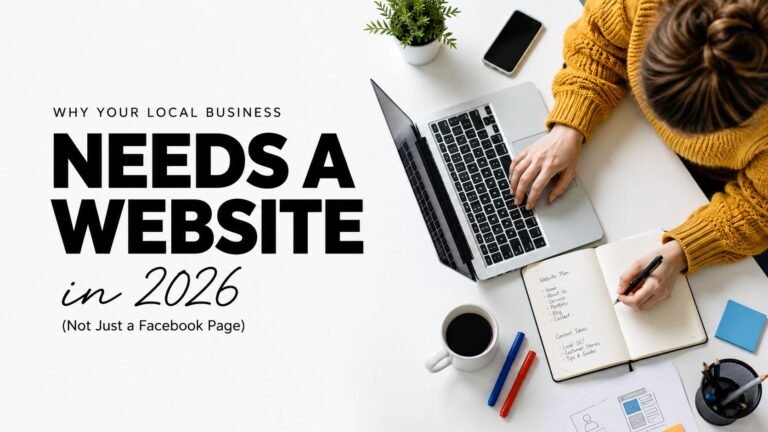
Let me ask you something honest. If a potential customer searched for your business right now on Google not Facebook, not Instagram would they find you?
If the answer is “probably not,” you’re leaving real money on the table. And in 2026, that gap between businesses with a proper website and those without is wider than it’s ever been.
I’ve worked with local businesses across New South Wales for years. The ones that are growing aren’t necessarily the ones with the best products. They’re the ones that made themselves easy to find. A Facebook page alone just doesn’t cut it anymore, and I want to explain exactly why.
Facebook Is Not Your Property
Here’s the thing people forget: your Facebook page doesn’t belong to you.
You’re renting space on someone else’s platform. Meta can change its algorithm overnight, restrict your reach, suspend your account, or simply decide that organic (unpaid) posts from business pages deserve almost zero visibility which, by the way, is already happening.
Facebook organic reach for business pages has been declining for years. In 2026, posting to your Facebook page without paying to boost it is like putting a sign in a room where nobody goes.
A website, on the other hand, is yours. Your domain, your content, your customers. Nobody can take it from you, reduce your reach, or change the rules.
Google Is Where Your Customers Start Their Search
Think about your own behaviour. When you need a plumber, a dentist, or a local café where do you go? Most people head straight to Google.
Your potential customers are doing the same thing. They’re typing things like “best café near Parramatta” or “emergency electrician Liverpool NSW” into Google. If you don’t have a website with that kind of content on it, Google has nothing to show them from your business.
Facebook pages do sometimes appear in Google results, but they’re limited. They show your page name, maybe a rating, and that’s about it. A proper website with well-written service pages, location content, and genuine helpful information? That’s what gets you real rankings.
Customers Trust Websites More Than Facebook Pages
This one surprises business owners when I tell them, but it shouldn’t.
Think about the last time you were trying to decide whether to trust a business. Chances are you Googled them, found their website, read through their services, looked for an About page, checked their contact details. That process is what builds confidence.
When someone lands on a Facebook page, they get a limited picture. There’s no space to explain what makes you different, no room to walk them through your services, no place to show testimonials in a structured, credible way.
A website lets you tell your full story. It’s your shopfront on the internet. And in Australia, where consumers are increasingly savvy about who they hand their money to, that shopfront matters enormously.
A Website Works for You Around the Clock
Your business has opening hours. Your website doesn’t.
Someone at 11pm searching for a physio clinic in Penrith can land on your website, read about your services, see your location and hours, and book an appointment all before you’ve even woken up the next morning.
That’s not possible with just a Facebook page. There’s no proper booking integration, no structured service information, no easy way for a stranger to go from “I need this” to “I’ll contact them” without friction.
A website removes that friction completely.
Google Business Profile Works Better When Backed by a Website
You’ve probably set up your Google Business Profile (formerly Google My Business) and that’s a smart move. But here’s what most local business owners don’t realise: your Google Business Profile performs significantly better when it’s connected to a proper website.
Google uses your website to understand what your business actually does. It reads your service pages, your location content, your blog posts. That information helps Google decide when to show your business in local search results.
Without a website, your Google Business Profile is working with one hand tied behind its back.
What Facebook Is Good For (And What It’s Not)
To be fair, I’m not saying delete your Facebook page. It has genuine uses.
Facebook is good for:
- Building community and engaging with existing customers
- Running targeted paid advertising
- Sharing updates, photos, and behind-the-scenes content
- Responding to messages from people who reach out there
Facebook is not good for:
- Being found by people who don’t already follow you
- Ranking on Google for local search terms
- Giving a professional first impression to new customers
- Housing the kind of detailed, structured content that builds trust
The smart approach is to use both but treat your website as the foundation and Facebook as a tool to drive people toward it.
The Businesses Winning Locally in 2026 Have Strong Websites
I see this pattern constantly. A tradie with a clean, well-written website that explains their services clearly and covers their local area is getting enquiries week after week from people who found them on Google. Their competitor with just a Facebook page is relying entirely on word of mouth and paid posts.
Word of mouth is valuable, but it has a ceiling. A website doesn’t.
The businesses growing their customer base in 2026 across greater Sydney and regional NSW are the ones that invested in a proper web presence. Not complicated, not expensive to maintain just solid, honest content that helps Google understand who they are and what they do.
What Your Website Actually Needs
If you’re going to build a website (or improve the one you have), keep it straightforward. You don’t need dozens of pages or fancy animations. You need:
A clear homepage that tells visitors immediately what you do and where you operate.
Dedicated service pages that go into detail on each thing you offer. Don’t cram everything onto one page Google rewards specific, focused content.
A proper About page that introduces your business, your team, and your story. People buy from people they trust.
A Contact page with your phone number, email, address, and if possible, an embedded Google Map.
If you serve specific suburbs or regions, a short page dedicated to each area can make a real difference to your local rankings.
That’s it. That’s the foundation. Everything else builds from there.
The Bottom Line
Your Facebook page is a useful tool. It’s not a business strategy.
In 2026, local customers in New South Wales are searching on Google before they pick up the phone. If your business isn’t showing up in those searches, if your only online presence is a Facebook page that barely gets seen, you’re invisible to a huge portion of people who could become loyal customers.
A website changes that. It works for you continuously, builds your credibility, and gives Google something to work with when deciding who to show in local results.
If you’ve been putting it off, now is the time to stop waiting. The businesses in your area that are growing online started building their web presence before they needed to. That’s the advantage and it’s still available to you.
NSW Business Today covers practical digital and business growth advice for local business owners across New South Wales. For more articles like this, browse our blog.