Most local business owners spend hours getting their website right but treat their Google Business Profile description like an afterthought. They write two generic sentences, hit save, and move on.
That’s a mistake — because your GBP description is often the first thing a potential customer reads before they ever visit your website.
Let’s talk about how to actually write one that works.
What Your Description Is Really Doing
Before writing a single word, understand what this space is for.
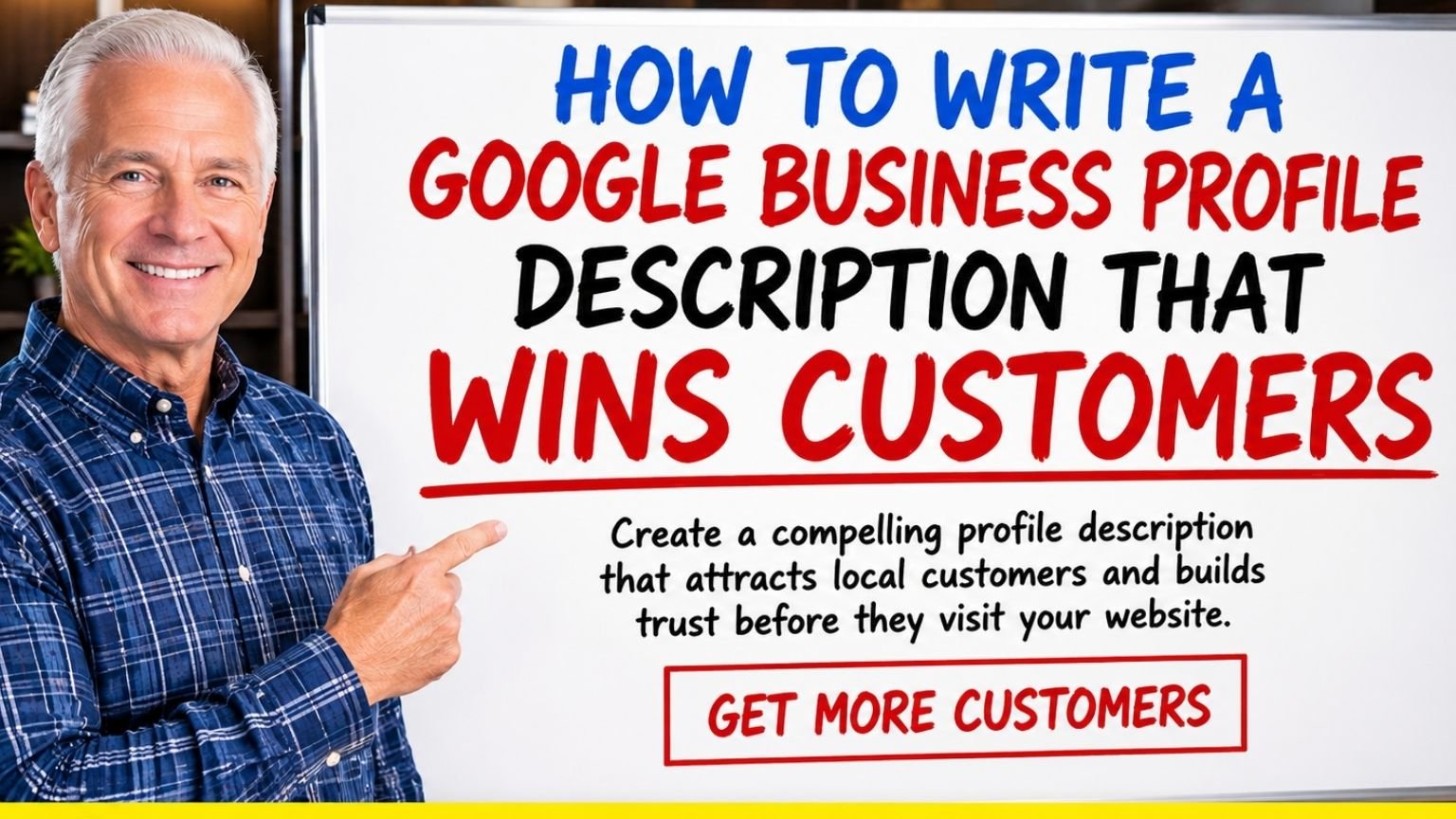
Your Google Business Profile description does not need to sell everything you do. It needs to answer one question in the reader’s mind: “Is this the right business for me?”
That’s it. When someone finds your listing, they’re already looking for what you offer. Your job is to give them a reason to choose you over the three other listings beside yours.
A strong description builds trust quickly, speaks to the right customer, and reflects how your business actually feels to walk into or work with.
The Basics You Can’t Skip
Google gives you 750 characters for your description. The first 250 characters show without the reader having to click “more.” That makes the opening lines the most important real estate you have.
Here’s what Google actually wants in this space, based on their own guidelines:
- A clear explanation of what your business does
- What makes you different from competitors
- The history or story behind your business (optional but effective)
- Information that helps customers decide
What Google does not want, and what can get your listing flagged or suppressed:
- Links or URLs
- HTML tags
- Promotional pricing (“50% off this week!”)
- Phone numbers or addresses (those live elsewhere on your profile)
- Keyword stuffing
Keep it clean, honest, and focused.
What Actually Works in 2026
Search behaviour has shifted. Google’s AI systems now evaluate your GBP description alongside your reviews, website content, and overall profile completeness to decide how relevant you are for a search.
This means keyword stuffing is not only ineffective — it actively works against you. Google can detect when a description reads like it was written for a search engine rather than a person.
What works instead is writing in plain language that matches how your customers actually talk when they describe your business.
Think about this: When a happy customer tells a friend about you, what do they say? “Oh, you should go to them — they’re really good at X and they’re actually Y.” That natural language, those specifics — that’s what belongs in your description.
A Framework That Works
Here’s a simple structure that holds up well for most local businesses:
Opening (first 250 characters): Who you are + what you do + who you serve. Be specific. “Family-owned plumbing company serving the Northern Beaches since 2008, specialising in emergency repairs and bathroom renovations for homeowners” is infinitely better than “We are a professional plumbing service providing quality solutions.”
Middle: What makes you different. This is not the place for generic claims like “great customer service” or “affordable prices.” Every competitor says that. Instead, name something real — your process, your team, your turnaround time, a specific thing you do that others don’t.
Closing: A subtle invitation. Where are you located? What area do you serve? What should someone do next? This isn’t a hard sell — just a natural close that points people in the right direction.
Words to Avoid
There’s a set of words that have been overused to the point of meaning nothing. If your description contains any of these, cut them out:
- “Passionate”
- “Dedicated”
- “One-stop-shop”
- “World-class”
- “Innovative solutions”
- “State-of-the-art”
Replace them with specifics. Instead of “passionate about helping our clients,” try “we stay on-site until the job is done right.” One is a feeling with no proof. The other is a commitment a customer can hold you to.
The Local SEO Connection
Your GBP description is one of many signals Google uses to determine your local relevance. On its own, it won’t make or break your ranking. But combined with everything else — consistent NAP (name, address, phone number) across the web, regular posts, strong reviews, photo updates — it becomes part of a complete profile that Google rewards.
One thing that has become more important going into 2026 is alignment. Google is increasingly comparing what you say in your GBP description with what your website says. If they’re wildly different in tone, focus, or the services they describe, that inconsistency can quietly work against you in local search results.
So whatever you write in your description should reflect what someone finds when they land on your website. Same services, same language, same business personality.
A Real Example (Before and After)
Before: “Welcome to Smith’s Auto Care. We are a professional and reliable automotive service provider offering a wide range of services. Our team of skilled technicians is passionate about delivering quality results. Contact us today for all your automotive needs.”
After: “Smith’s Auto Care has been looking after cars in Parramatta for over a decade. We specialise in logbook servicing, brake repairs, and pre-purchase inspections for all makes and models. No upselling, no jargon — just straight answers and honest work. Family-run with a five-day turnaround guarantee on most services.”
The second version is longer on substance and shorter on noise. It tells you what they do, where they are, who they are, and what to expect. A customer reading that knows immediately whether this is their kind of place.
Don’t Set and Forget
Your business evolves. Your description should too.
Review it every few months. If you’ve added a new service, expanded your area, or shifted your focus, update the description to match. A description that no longer reflects your business is doing you no favors.
Also check your description after any major Google updates. Google periodically changes how it processes and displays business information, and what worked well last year may need a small adjustment to perform well today.
Final Thought
Your Google Business Profile description is a short piece of writing with a real job to do. It’s not the place to be vague or impressive-sounding. It’s the place to be clear, honest, and specific enough that the right customer recognises themselves in what you’ve written.
Write it like you’re talking to someone standing at your front door, trying to decide whether to come in. What would you say?
Start there.
Part of our local SEO series for Australian small business owners. For more guides like this, visit nswbusinesstoday.com