If you run a local business in Australia, Google Maps is not optional anymore. It is where your next customer is deciding right now whether to call you or your competitor. The good news is, most local businesses are doing it wrong which means there is real room for you to get ahead.
This guide walks you through exactly what works in 2026, based on how Google’s local search algorithm actually behaves today.
Why Google Maps Rankings Matter More Than Ever in 2026
Think about the last time you searched for a tradie, a café, or a dentist. You probably typed something like “plumber near me” or “best café in Parramatta” and you clicked one of the top three results on the map. That top three section is called the Local Pack, and it gets the majority of clicks before anyone scrolls to the regular search results.
If your business is not showing up there, you are invisible to a massive portion of local buyers regardless of how good your service actually is.
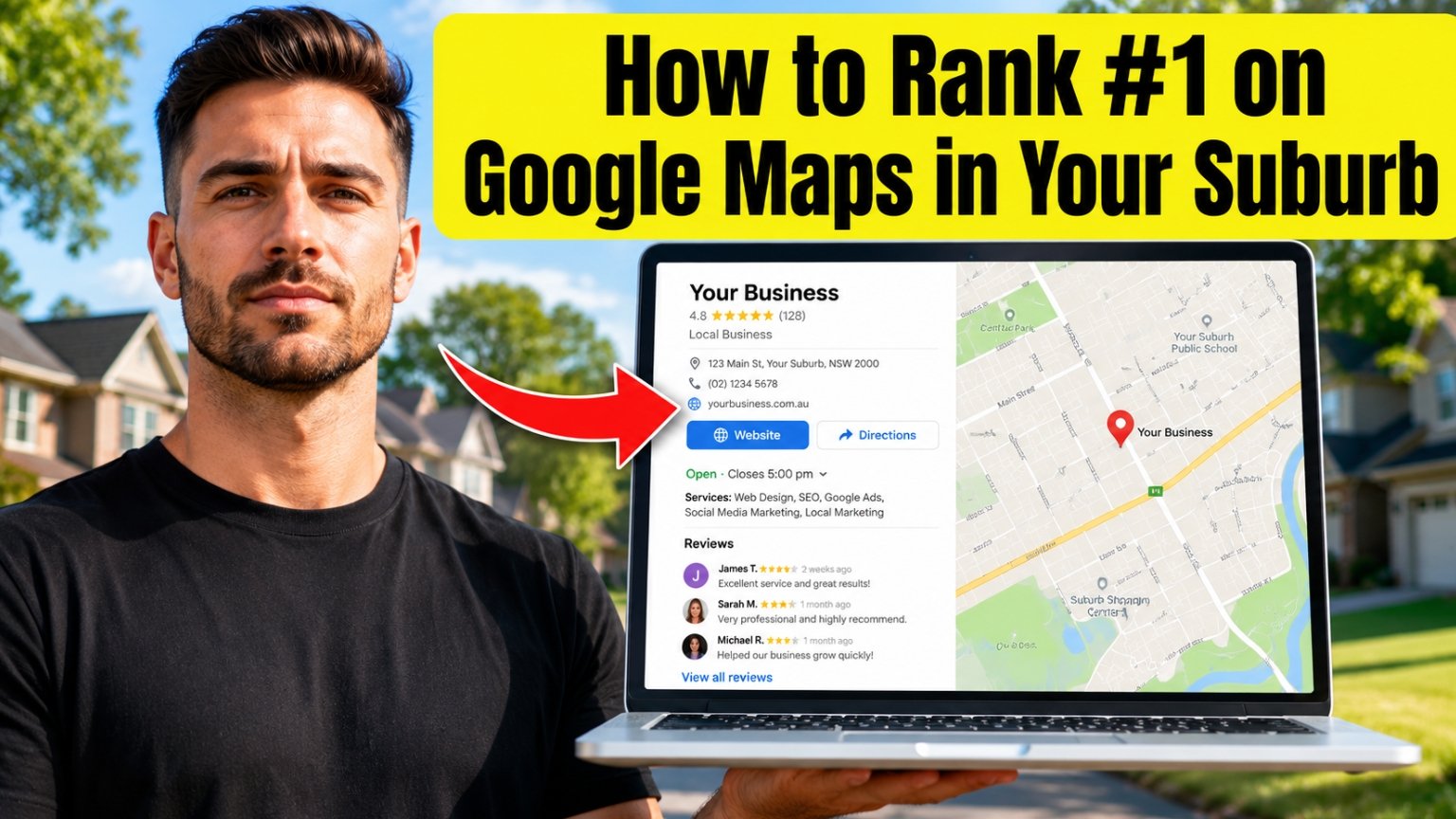
Your Google Business Profile Is the Foundation
Your Google Business Profile (GBP) used to be called Google My Business. Whatever you call it, it is the single most important thing you control for local rankings.
Here is what most business owners get wrong: they set it up once and forget it. Google treats your profile like a living document. Profiles that are regularly updated, complete, and active consistently outrank neglected ones.
What complete actually means:
- Every field filled in name, address, phone, website, hours, and holiday hours
- Your primary category chosen carefully (this is the most important category signal Google uses)
- Secondary categories added where they genuinely apply
- A proper business description that includes your suburb name and what you do naturally
- At least 10 photos exterior, interior, team, work examples updated regularly
- Services or products listed with descriptions
- Questions answered in the Q&A section before customers even ask them
One thing many businesses miss is the service area setting. If you travel to customers (like a mobile mechanic or a cleaning service), make sure your service area is set correctly. Google needs to know which suburbs you actually cover.
Your Business Name, Address, and Phone Must Be Consistent Everywhere
This is called NAP consistency Name, Address, Phone and it matters a lot more than people realise.
Google cross-references your business information across the entire web. If your address is listed as “Level 1, 42 Main Street” on your website but “42 Main St, Suite 1” on a directory, Google picks up that inconsistency as a trust signal problem.
Go through every place your business is listed online:
- Your website (header, footer, contact page)
- Google Business Profile
- Yellow Pages Australia
- True Local
- Yelp
- Any industry directories relevant to your trade
Make sure the name, address, and phone number are word for word identical across all of them. This alone can move you up in local rankings because it increases Google’s confidence that you are a legitimate, established business.
Reviews Are the Strongest Local Ranking Signal in 2026
Google has made this clearer than ever. Reviews the quantity, the recency, and the quality of your responses directly influence where you appear in the Local Pack.
A business with 80 reviews at a solid average will outrank a competitor with 12 reviews at a higher average. Recency matters too. A business that gets two or three new reviews every month tells Google it is still actively serving customers.
The honest way to get more reviews:
You cannot pay for reviews or manufacture them. Google’s systems are very good at detecting this and the penalty is severe. What you can do is make it genuinely easy for happy customers to leave one.
- Ask at the right moment. Right after a job is finished and the customer is happy is the best time not a week later in a follow-up email when they have moved on.
- Send a direct link. Go to your Google Business Profile, find the “Get more reviews” button, copy that link, and send it to customers. The fewer steps, the better.
- Train your team to ask. If you have staff, a simple “If you were happy with us today, it would mean a lot if you left us a Google review” goes a long way.
Responding to reviews matters for rankings too. When you respond to every review, good or bad Google sees an engaged business owner. Your responses also show up publicly, which builds trust with potential customers reading them.
When responding to negative reviews, stay calm and professional. A well-handled negative review often builds more trust than a page of five-star ones, because it shows you are real and accountable.
Your Website and Your Google Business Profile Need to Work Together
A lot of local businesses treat their website and their Google profile as separate things. They are not. Google looks at both together to decide how authoritative your business is for a local search.
Your website needs to clearly signal the suburb or suburbs you serve:
- Your homepage title tag should include your suburb and your service (“Electrician in Penrith | NSW Business Name”)
- Your footer should have your full address
- Create a dedicated contact page with your address, an embedded Google Map, and your phone number written as text (not just an image)
- If you serve multiple suburbs, create a separate page for each one written genuinely for that area, not just a copy-paste with the suburb name swapped out
Schema markup is worth mentioning here too. It is a small piece of code you (or your web developer) add to your website that tells Google exactly what type of business you are, your location, your hours, and your contact details in a format Google reads easily. Most website platforms have plugins that handle this, but if yours does not, it is worth getting done.
Local Citations Still Matter But Quality Beats Quantity
A citation is any place online that mentions your business name, address, and phone number together. A decade ago, the strategy was to get listed on as many directories as possible. That approach is outdated.
In 2026, a handful of high-quality, relevant citations is worth more than hundreds of low-quality ones.
Focus on:
- The major Australian directories (Yellow Pages, True Local, Hotfrog)
- Your industry’s specific directories (like HiPages or ServiceSeeking for trades, Healthengine for healthcare, etc.)
- Your local council’s business directory if one exists
- Local community or chamber of commerce listings
The key is that these citations are consistent with your NAP and ideally link back to your website.
Proximity, Relevance, and Prominence How Google Actually Decides
Google publicly says its local ranking is based on three things:
Proximity How physically close your business is to the person searching. You cannot change this, but it is why ranking in “your suburb” specifically is achievable even if you cannot rank for the entire city.
Relevance: How well your business matches what was searched. This is where your categories, your profile description, your services, and your website content all come together. The more clearly you communicate what you do and where you do it, the more relevant Google considers you.
Prominence: How well-known and trusted your business is. This is where your reviews, your website authority, your citations, and your overall online presence feed in.
The biggest mistake most local businesses make is only focusing on one of these. Optimising all three together is what moves you into the top three.
What Most Competitors Are Not Doing (That You Should)
After working with local businesses across New South Wales, a few things consistently separate the ones ranking in the top three from the ones stuck on page two:
Posting to Google Business Profile regularly. Most business owners do not know you can post updates, offers, and photos directly to your Google profile. These posts show up on your listing and signal activity to Google. Even one post per week makes a noticeable difference.
Using the “Products” and “Services” sections properly. Adding detailed services with descriptions gives Google more context about what you do and helps you appear for more specific search terms.
Building genuine local backlinks. A link from your local newspaper, a suburb-specific blog, or a community organisation is worth far more than links from generic directories. Sponsor a local event, contribute to a local publication, or get involved with your local business chamber these things generate the kinds of links that move the needle in local search.
A Note on Patience
Local SEO is not instant. If you implement everything in this guide today, you might see meaningful movement in your rankings within four to eight weeks. Some things take longer. The businesses that dominate their suburb’s local search results are the ones that treat this as an ongoing habit not a one-time task.
The work compounds. Every review you collect, every post you publish, every citation you build adds to your profile’s authority in a way that becomes increasingly hard for competitors to overtake.
Start with your Google Business Profile today. Make sure it is complete, accurate, and active. Everything else builds on top of that foundation.
nswbusinesstoday.com publishes practical, no-nonsense business advice for local businesses across New South Wales. If you found this useful, explore our other guides on local marketing and business growth.